
The Myth of the "Correct" Downward Dog
Let’s explore alignment, lineage, and intention in Adho Mukha Svanasana. One of the most common questions I hear from students is:
“What’s the correct position for Downward Facing Dog?” It’s a great question, and a tricky one. Like many shapes in our yoga practice, there isn’t one “correct” version of Adho Mukha Svanasana. Instead, there are guidelines, explorations, and adaptations, all of which shift depending on tradition, intention, and individual anatomy. Let’s take a moment to look back at some of yoga’s foundational texts and teachers, and how their expressions of Downward Dog reveal the depth and variation in this seemingly simple pose.
In Yoga Makaranda, Krishnamacharya, the teacher of both B.K.S. Iyengar and K. Pattabhi Jois offers a brief but potent description of Down Dog:
"Place the chin on the chest and draw the stomach in."
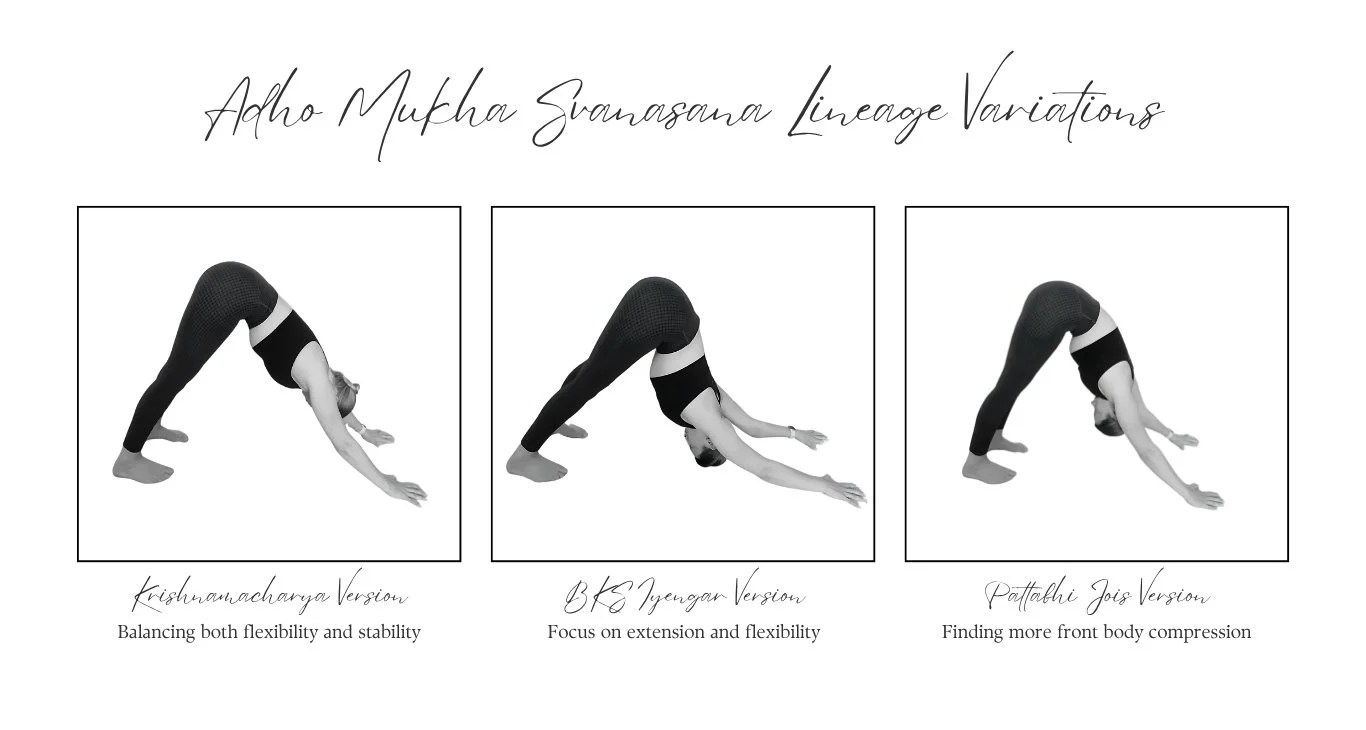
The photo in his book shows a medium length dog, with super straight spine but, a tucked tailbone and rounded lumbar spine. It's more about containment than length.
In contrast, Iyengar’s Light on Yoga presents a deeply extended Down Dog, his legs and arms are fully stretched, heels rooted, chest reaching back, and the crown of the head touching the floor. His version expresses maximum length, flexibility, and precision.
Then we have Yoga Mala by Pattabhi Jois. His Down Dog sits at a slightly shorter length than the other two. The whole spine rounds slightly more, the navel is the drishti (gaze point), and the core is strongly activated, emphasizing strength and control over depth.
Each interpretation is valid. Each offers a different experience. Your job is to explore them and find what serves your practice best. There are so many variables in this pose, from shoulder mobility to hamstring length, to spinal curves and wrist strength. What works for one body might not feel right in another. So here are a few things to consider as you build your unique version of Down Dog:
Heels don’t have to touch the floor. They might, over time, as your tissues open and adapt. But for many, due to skeletal structure or lifestyle patterns, they won’t. That’s okay. Let the knees bend if needed. Prioritize length in your spine over straight legs.
Spread the fingers evenly and press through all four corners of the hand. Start with shoulder-width placement. If you’re hypermobile, keep a micro-bend in the elbows to avoid dumping into the joints.
You might’ve heard the cue “draw the shoulders away from the ears.” Let’s reframe that. When you reach overhead (like in Down Dog), your shoulder blades naturally elevate and rotate upward, don’t fight this. Instead, push the floor away, let the shoulders lift, and create strength with external rotation.
My favorite cue:
“Hide your armpits like someone’s about to tickle you.”
This wraps the scapula outward and helps broaden the upper back.
Let the head curl under and gaze toward the navel to create length through the back of the neck. Then, gently draw the lower belly in and drop the tailbone slightly. This subtle adjustment brings awareness to Mula Bandha (pelvic floor activation) and gives you a sense of energetic lift.
You don’t have to choose one style of Downward Dog and stick to it forever! In fact, part of the beauty of the pose lies in its adaptability. Each yoga master offered a distinct version based on their understanding, intention, and the bodies they were working with. Iyengar’s long, extended dog emphasizes flexibility and spinal lengthening, in your practice inviting you to soften the knees and press the chest toward the thighs. Jois’ version, more compact and core-focused, builds internal strength and control which you can explore through lifted heels and a slightly rounded spine. Both are powerful in their own way, and both are valid. These expressions, and others are available to you at any time, depending on what your body needs. Your practice is not static, and neither is this pose. Some days, you may crave length and expansion; other days, stability and grounding. Let each variation serve you as a tool, not a rule, an invitation to explore, adapt, and meet yourself exactly where you are.
Downward-Facing Dog is a shape you’ll visit thousands of times in your yoga life. Don’t rush to lock it in. Instead, stay curious. Explore the teachings of Krishnamacharya, Iyengar, and Jois. Notice how each era and style offered something new, not because one was wrong, but because yoga evolves, and so do we. There’s no black-and-white answer for your body. If something doesn’t feel right ask why. If everything feels too easy change it up and try a new approach. Let the pose be a place of investigation, not performance. Let lineage guide you, but not limit you. And above all keep learning and being curious!
Suggested Reading:
Yoga Makaranda by T. Krishnamacharya
Light on Yoga by B.K.S. Iyengar
Yoga Mala by Sri K. Pattabhi Jois